Abstract
This research note develops a circle-based geometric scale model from a single fixed reference: Earth E1 diameter = 100%, corresponding to 12,756 km. The model preserves the previously defined Moon reference circle M1 and the three concentric Earth–Moon boundary-comparison circles I2I, C2C and O2O, then introduces a sixth circle, EOC (Earth Outer Circle). EOC is centred exactly on Earth E1 and extends from the Earth centre to the far outer wall beyond the Moon side. The full EOC is divided into exactly 30 equal angular sectors of 12° each. The construction is intentionally geometric rather than pictorial: all circles remain perfect, all radii and diameters are proportional to Earth, and no orbit ellipse, perspective, texture or decorative astronomy is introduced.
Research objective
The objective is to create one reproducible mathematical drawing in which several Earth–Moon linear distances can be compared without changing the master reference. Earth is never renormalized. E1 remains 100% whether a comparison circle is smaller or more than sixty times the Earth diameter.
The study asks two related questions. First, how can the Earth, Moon and three previously defined boundary spans be retained in one exact proportional system? Second, what new geometry appears when a full Earth-centred circle is constructed with a radius equal to the Earth-centre-to-far-Moon-wall distance and that circle is divided into 30 equal angular sections?
Fixed reference system
The model uses the supplied physical dimensions as fixed modeling inputs. Every percentage in the diagram is expressed relative to the physical Earth diameter of 12,756 km, which is defined as exactly 100%.
| Circle | Definition | Diameter | Diameter % | Radius | Radius % |
|---|---|---|---|---|---|
| M1 | Moon reference circle | 3,475 km | 27.24% | 1,737.5 km | 13.62% |
| E1 | Earth master reference circle | 12,756 km | 100% | 6,378 km | 50% |
| I2I | Facing Earth surface to facing Moon surface | 397,384.5 km | 3,115.28% | 198,692.25 km | 1,557.64% |
| C2C | Earth centre to Moon centre | 405,500 km | 3,178.90% | 202,750 km | 1,589.45% |
| O2O | Far Earth edge to far Moon edge | 413,615.5 km | 3,242.52% | 206,807.75 km | 1,621.26% |
| EOC | Earth-centred circle reaching the far outer Moon-side wall | 814,475 km | 6,385.03% | 407,237.5 km | 3,192.52% |
Master scale rule
For a physical diameter D, the Earth-relative diameter scale is:
For a physical radius R, the stated radius percentage is expressed against the same Earth-diameter master:
This convention is important. The radius percentages are not percentages of the Earth radius; they are percentages of the fixed Earth diameter. Therefore E1 radius is 50%, while E1 diameter is 100%.
Deriving the three Earth–Moon boundary circles
The three imaginary comparison circles I2I, C2C and O2O share one exact centre in the diagram. C2C uses the fixed center-to-center input of 405,500 km. The two boundary circles are produced by subtracting or adding the Earth radius and Moon radius.
The combined Earth-plus-Moon radial amount is 8,115.5 km. Because the same amount is removed from C2C to form I2I and added to C2C to form O2O, the three large comparison diameters are symmetric around C2C in physical-distance space.
Introducing the Earth Outer Circle (EOC)
EOC is not centred on the common comparison-centre merely as a graphical convenience. Its defining condition is explicit: the centre of EOC is exactly the centre of Earth E1. Starting from that Earth centre, the EOC radius reaches to the far outer wall beyond the Moon side.
The EOC radius is obtained by adding the fixed Earth-centre-to-Moon-centre distance to the Moon radius:
Doubling this radius produces the complete EOC diameter:
Under the Earth-diameter master scale, the stated proportional values are:
EOC circumference
With EOC radius fixed at 407,237.5 km, its circumference is calculated using the standard circle relation:
This circumference becomes the reference for the angular-sector experiment. The circular boundary itself is not altered; it is simply divided by radial lines drawn from the exact E1/EOC common centre.
Thirty equal angular sections
The complete EOC circle contains 360°. Dividing it into exactly 30 equal sectors gives:
Each sector therefore represents one-thirtieth of the complete circumference:
The corresponding outer arc length is:
The angular quantity is 12 degrees, not 12 percent. Thirty equal sectors at 12° exactly complete 360°.
Updated geometric construction
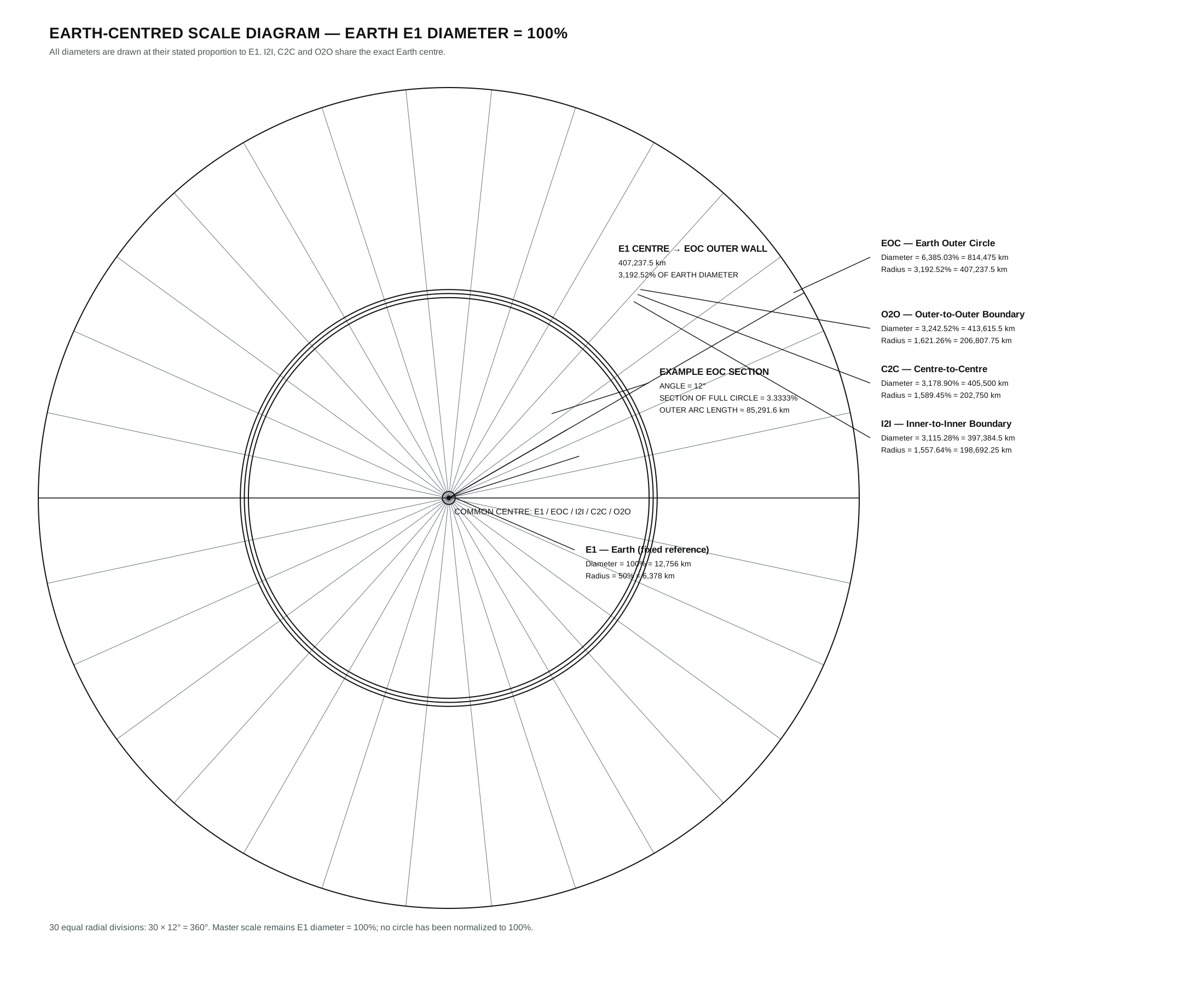
The new construction now contains six exact circle sizes. E1 and M1 are maintained as scale references, I2I–C2C–O2O remain concentric for close boundary comparison, and EOC is a separate Earth-centred full circle whose centre is identical to the centre of E1.
One diameter line passes through the exact centre of each circle. The EOC contains exactly 30 radial divisions from the Earth/EOC common centre to the outer boundary, with neighboring lines separated by 12°. One radius is explicitly identified as E1 CENTER → EOC OUTER WALL and corresponds to 407,237.5 km or 3,192.52% of the Earth diameter.
Reading the diagram
The smallest reference is M1 at 27.24% of E1 diameter. E1 itself is 100%. I2I, C2C and O2O are all slightly above thirty-one Earth diameters and consequently appear close together at the common comparison centre. EOC is much larger, at 6,385.03% of Earth diameter, because its stated radius already represents 3,192.52% of Earth diameter and the full circle doubles that radial span.
The purpose of the layout is comparison, not celestial illustration. The circular forms represent chosen linear quantities. They are not physical orbit paths, and the radial sector lines are a mathematical partition of EOC rather than trajectories or directions of motion.
Scale reproducibility
The geometry can be reproduced at any drawing size by selecting a drawing diameter for E1 and multiplying it by each stated diameter percentage divided by 100. For example, if E1 is 100 drawing units in diameter, M1 is 27.24 units, I2I is 3,115.28 units, C2C is 3,178.90 units, O2O is 3,242.52 units and EOC is 6,385.03 units. No visual estimation is required.
For the EOC sector division, radial lines are generated at 0°, 12°, 24° and so on through 348°. This produces exactly 30 rays around the common Earth/EOC centre. A full diameter line may coincide with two opposite radial directions but remains a distinct measurement concept: it measures the complete 814,475 km EOC span through the centre.
Master size list
| Order | Circle | Diameter % of Earth | Diameter km |
|---|---|---|---|
| 1 | M1 | 27.24% | 3,475 km |
| 2 | E1 | 100% | 12,756 km |
| 3 | I2I | 3,115.28% | 397,384.5 km |
| 4 | C2C | 3,178.90% | 405,500 km |
| 5 | O2O | 3,242.52% | 413,615.5 km |
| 6 | EOC | 6,385.03% | 814,475 km |
Earth–Moon EOC 30-Section Scale Diagram
Open the exact scalable SVG used in this updated research note. The drawing contains the Earth-centred EOC construction and the 30 equal 12° radial divisions.
Conclusion
The updated model extends the earlier Earth–Moon boundary-circle comparison without changing its master scale. Earth E1 remains exactly 100%; M1 remains 27.24%; I2I, C2C and O2O retain their fixed proportional diameters; and the new EOC is introduced at 6,385.03% of Earth diameter with a radius of 407,237.5 km. Dividing EOC into 30 equal sectors produces a precise 12° angular interval, a 3.3333% circumference share per section and an outer arc of approximately 85,291.6 km per section. The result is a reproducible engineering-style geometric framework in which both radial distance and angular partition are expressed while the Earth diameter remains the sole 100% reference.