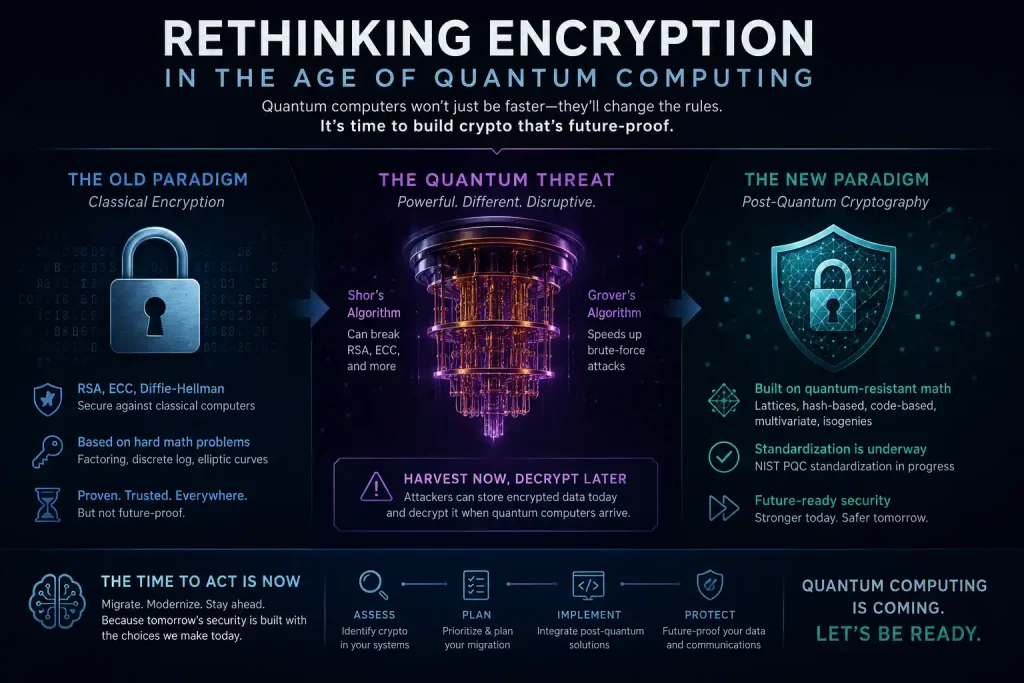
Rethinking Encryption in the Age of Quantum Computing
A research note on how the arrival of powerful quantum computing changes the questions we ask about long-term data security and cryptographic design.
Read article →An exploratory project asking how secure communication architectures should adapt as quantum computing changes long-term cryptographic assumptions.
Research and experimentation phase.
This is not presented as a finished cryptographic method. It is a documented investigation into architecture, assumptions and migration.
The project began with a question about the future impact of quantum computing on modern encryption. Instead of looking only at which algorithm replaces another algorithm, the research considers how systems can become easier to adapt when cryptographic assumptions change.
How should long-lived sensitive data be classified? Which cryptographic dependencies are hardest to replace? How can systems separate components so that a change in one security primitive does not force a complete redesign? How should theoretical claims be separated from implementation evidence?
Future updates will document theoretical foundations, small implementation experiments, migration considerations and limitations. Each new result will be linked from this stable project page.
A research note on how the arrival of powerful quantum computing changes the questions we ask about long-term data security and cryptographic design.
Read article →Good technology decisions begin before the tool choice: with a clear problem, explicit constraints and a way to verify the result.
Read article →