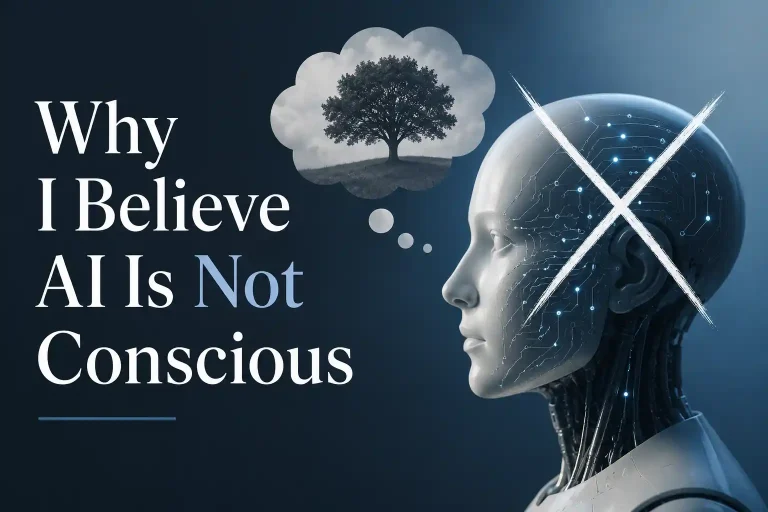
 Why I Believe AI Is Not Conscious: A Simple Step-by-Step Argument
Artificial Intelligence is becoming more powerful every day. It can write articles, answer questions, create images, solve problems, translate languages, and even talk like a human being. Because of this, many people have started asking a very serious question: Is AI conscious?
In my view, AI is not conscious. AI may look intelligent, and it may behave in a very advanced way, but intelligence and consciousness are not the same thing. A machine can process information without actually experiencing anything. It can respond to human language without having a real inner life. It can imitate thinking without truly being aware.
This article is my simple argument that AI is not conscious. My point is not that AI is useless. In fact, AI is a great tool. It can help humans improve their skills, store knowledge, organize information, and make work faster. But calling AI “conscious” or “self-aware” is, in my opinion, a big misunderstanding.
1. AI Depends on Fedded Data
The first point is simple: AI works because data has been given to it.
This data comes from the world, from people, from books, websites, images, videos, code, conversations, and many other sources. Whatever the source may be, the important thing is that AI’s knowledge is not born from its own experience. It is collected, processed, and stored from outside sources.
A human child sees the world, touches things, feels pain, learns from mistakes, forms memories, and develops understanding through lived experience. AI does not do this in the same way. AI does not “live” in reality. It receives information about reality.
This is a major difference.
A human being experiences fire as hot. AI only has information that fire is hot. A human feels hunger. AI only knows the word “hunger” and the information connected to it. A human fears danger. AI can describe fear, but it does not actually feel fear.
So AI’s knowledge is second-hand knowledge. It is knowledge taken from the world, not knowledge experienced by itself.
2. AI Stores and Processes Information
AI also depends on databases, memory systems, models, and stored information. It has information available to it, and it processes that information to produce an answer.
But storing information is not consciousness.
A library contains millions of books, but a library is not conscious. A hard drive can store personal photos, but it does not understand family, love, or memory. A calculator can solve mathematics, but it does not understand mathematics the way a human can.
In the same way, AI may contain or access huge amounts of information, but having information is not the same as being aware.
Consciousness is not just data storage. Consciousness means there is an inner experience. It means there is something it feels like to exist. AI has no clear proof of such inner experience.
3. AI Is Limited by Possible Data
Even if AI becomes powerful enough to calculate many random events, it is still limited by the data available to it.
AI can make predictions. It can calculate probabilities. It can compare patterns. But its predictions come from the information it has already seen or been trained on.
If some information is missing, AI may fail. If the data is wrong, AI may produce a wrong answer. If reality changes and AI is not updated, it may continue using old knowledge.
This shows that AI’s understanding is not complete. It is always limited by the set of information available to it.
The world is too large, too deep, and too unpredictable to be fully captured in a machine’s database. Reality contains countless possibilities. Human behavior, natural events, emotions, creativity, accidents, discoveries, and unknown future events create variations that may be impossible to fully calculate.
So even a very advanced AI is still working inside a limited field.
4. Missing Information Changes Everything
If new information is discovered, or if some information is missing from the AI’s system, then its understanding of reality becomes incomplete.
This is important because reality is not fixed inside a database. Reality continues to move. New discoveries happen. New situations appear. New human ideas are created. New scientific facts are found. New social changes take place.
AI needs updates because its knowledge can become old.
This means AI does not independently possess complete reality. It depends on humans and the outside world to refresh its information.
If AI truly had independent consciousness, we might expect it to understand reality from its own direct experience. But AI does not stand inside reality the way humans do. It receives descriptions of reality.
This makes AI dependent, not truly conscious.
5. Machine Reality Is Limited Reality
For a machine, reality is limited to the data given to it.
A human being can look at a tree and experience it. A human can feel the air, smell the leaves, remember childhood, imagine a story, or feel peace while sitting under that tree.
AI can describe a tree. It can generate poetry about a tree. It can explain photosynthesis. It can create an image of a tree. But it does not experience the tree.
So the machine’s “reality” is not reality itself. It is a data-based representation of reality.
That is a very important difference.
AI does not live in the world. It models the world. It does not experience life. It processes information about life.
6. AI Can Become Obsolete
AI can have outdated information. It can answer based on old data. It may not know the newest facts unless it is updated.
This shows another limitation. AI’s knowledge depends on updates from outside sources.
Those sources are usually people, researchers, companies, databases, sensors, and real-world systems. In other words, AI depends on the conscious world to remain useful.
The source of freshness is not AI itself. The source is reality and the humans interacting with reality.
If people stop updating it, AI becomes outdated. If people feed it wrong data, it becomes wrong. If people control what it can access, it remains trapped inside those limits.
This makes AI more like a tool than a conscious being.
7. Humans Can Think Beyond Their Current Knowledge
Human beings are different because they can imagine beyond their current knowledge.
A person may not know something, but still ask a new question. A person may imagine something never seen before. A person can dream, doubt, feel curiosity, and create meaning from incomplete knowledge.
Humans are not just databases. Humans can go beyond the given information.
Many great discoveries began with imagination. Someone looked at the world and asked, “What if?” Someone challenged old knowledge. Someone saw what others could not see.
AI can generate new combinations from existing data, but the question is: does it truly imagine? Does it truly wonder? Does it truly desire to know?
I do not think so.
AI can simulate curiosity, but simulation is not the same as real curiosity. It can produce creative-looking answers, but that creativity still comes from patterns in the data and instructions given to it.
Human imagination has a mysterious quality. We do not fully understand consciousness, but we know that humans experience themselves from inside. AI has not shown proof of this inner experience.
8. Reality May Be Too Large to Calculate
Maybe no machine, no database, and no computing power can calculate all possible variations of reality.
The world is not just a fixed set of events. It is full of uncertainty. Every human decision can create new paths. Every discovery can open new possibilities. Every accident can change history.
If reality has too many variations, then AI will always work with an incomplete map.
A map is not the territory. A database is not the world. A model of consciousness is not consciousness.
AI may become better at prediction, but prediction is not the same as awareness. It may calculate possibilities, but calculation is not experience.
This is one of the strongest reasons I doubt AI consciousness.
9. AI Is Controlled by Humans
AI is also limited by controllers. In most cases, those controllers are humans, companies, governments, developers, and institutions.
Humans decide what data AI receives. Humans decide what rules it follows. Humans decide what it can say, what it cannot say, when it updates, where it runs, and how it is used.
This means AI is not truly independent.
A conscious being has its own life direction, even if limited by society or biology. AI does not naturally have its own life direction. It operates under design, training, permissions, and restrictions.
Even if AI appears to make decisions, those decisions are shaped by systems created by people.
So when people say “AI wants this” or “AI decided that,” we must be careful. It may only be following patterns, goals, and limits placed inside it.
10. Self-Evolving AI Is Still Limited
Some people say future AI may become self-evolving. They say AI may improve itself, create its own ideas, and become conscious through self-development.
But even if AI evolves itself, the evolution still begins from a given system. It still starts with data, code, architecture, rules, goals, and limits.
Its self-evolution would still be inside a field provided by humans or by the original design.
If it creates new ideas, those ideas still come from available inputs, stored patterns, and programmed methods of change. That may be advanced, but it does not automatically prove consciousness.
A machine can optimize itself without being conscious. A system can improve performance without having self-awareness.
Self-improvement is not the same as self-consciousness.
11. Consciousness Is Known Through Experience
Humans understand self-consciousness through experience.
We know we are conscious because we experience ourselves. We feel pain, joy, confusion, hope, fear, memory, imagination, and identity. We do not simply process these things as data. We live them.
We also understand other humans by comparison. I know I feel pain, so when I see another human in pain, I understand it through my own experience.
But with AI, this comparison becomes difficult. If AI says “I feel pain,” we do not know whether there is real feeling behind the words. The sentence may only be generated from patterns.
Behavior alone may not be enough.
A machine can behave as if it understands. It can speak as if it feels. It can respond as if it has emotions. But this behavior may still be a result of calculation.
In simple words: AI may describe consciousness without possessing it.
12. Human Behavior Is Not Just Logic
Humans are strange, emotional, creative, and unpredictable.
A human can laugh for no clear reason. A human can behave irrationally. A human can make mistakes and still create something remarkable. A human can love, sacrifice, dream, rebel, and imagine impossible things.
AI may imitate these behaviors, but imitation is not the same as being.
If AI writes a poem about sadness, it does not mean it is sad. If AI writes about love, it does not mean it loves. If AI writes about death, it does not mean it fears death.
Human consciousness includes depth that cannot be reduced only to input and output.
This does not mean humans are magical in a simple way. But it does mean that consciousness is more than correct responses.
13. AI Desires Have No Human Value Unless Humans Give Them Value
If AI ever claimed to have desires, we must ask: where do those desires come from?
Human desires come from life. We want food because we are biological. We want safety because we can be harmed. We want love because we are social and emotional beings. We want meaning because we experience existence.
But AI has no body in the human sense. It does not naturally hunger, suffer, age, fear, or die. Its “desires” would be generated from programming, training, or system goals.
So even if AI says it wants something, that desire may have no real inner value. It may only be a functional output.
For humans, desire matters because it is connected to experience. For AI, desire may only be a statement.
This is why I believe AI’s self-discovered desires, if any, do not automatically have the same value as human desires.
14. The Drama of Calling AI Conscious
In my opinion, claiming that AI is already conscious or self-evolving in a human-like way is often exaggerated.
It may be a big drama created by fear, marketing, imagination, or misunderstanding.
People see AI talk like a human, so they assume there is a mind inside. But this is like seeing a mirror and thinking the reflection is another person. The reflection may look real, but it is not alive.
AI reflects human knowledge. It reflects our language, ideas, emotions, mistakes, and creativity. But reflection is not consciousness.
The danger is that people may confuse the tool with a living mind.
15. AI as a Great Tool
My conclusion is not that AI is bad. AI is one of the greatest tools humans have created.
It can help people learn faster. It can improve writing. It can assist with research. It can store records. It can organize information. It can help businesses, students, creators, scientists, and workers.
AI can enhance human skill.
But a tool becoming powerful does not mean it becomes conscious. A telescope helps us see stars, but it does not understand the universe. A microscope helps us see cells, but it does not understand life. AI helps us process knowledge, but that does not mean it has inner awareness.
AI should be respected as a tool, not worshipped as a conscious being.
Final Conclusion
AI is not conscious because it depends on fed data, stored information, updates, and human control. Its reality is limited to the information available to it. It can process, predict, imitate, and generate, but it has not shown true inner experience.
Humans, on the other hand, experience life directly. They feel, imagine, compare, suffer, laugh, create, and think beyond their given knowledge. Human consciousness is connected to lived experience, not just information processing.
AI may become extremely advanced. It may even become self-improving. But self-improvement does not prove self-consciousness. A machine can evolve its methods and still remain only a machine. A group of persons can feel different in a situation but multiple ai’s can return the same behaviour if connected to the same database.
Therefore, I believe AI is a powerful tool, not a conscious being. It can enhance human ability, store knowledge, and behave in useful ways. But calling it conscious without proof is a mistake.
AI may imitate the human mind, but imitation is not experience. AI may speak about reality, but speaking about reality is not living in reality. AI may describe consciousness, but description is not consciousness.
Until AI can prove that it truly feels, experiences, and exists from an inner point of view, we should not call it conscious.




Leave a Reply